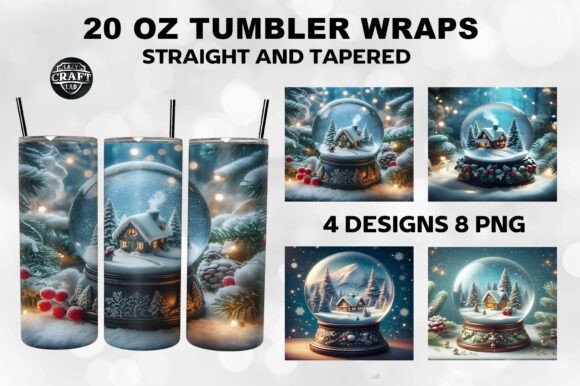
Snow Globe with Winter Scene Tumbler PNG
First Impressions: A Delicate, Festive Vibe — But Is It Embroidery-Ready?
When I opened Snow Globe with Winter Scene Tumbler PNG, I felt that quiet hush of early December—soft snow, glowing windows, a sense of stillness inside the glass. Visually, it’s charming: a centered snow globe with a miniature winter landscape—tiny evergreens, a cottage roof dusted white, maybe a deer or a bird perched on the rim. The composition is balanced, not too busy, and clearly built for vertical wrapping on a skinny 20oz tumbler. But here’s what I asked myself immediately: How does this translate to thread, not ink? Because while sublimation thrives on fine detail and gradients, embroidery lives by stitch count, density, and fabric behavior.
A Real-World Test: Turning It Into an Embroidered Holiday Tote Bag
Last week, I prepped a custom holiday tote for a local boutique—cotton canvas, medium weight, meant for gift-giving. I wanted something nostalgic but clean, so I considered adapting Snow Globe with Winter Scene Tumbler PNG as a focal embroidery motif. Not as a full wrap, but cropped and scaled to fit a 4x4 hoop. What worked? The central globe shape held up beautifully in satin stitch—it read clearly at 3.5 inches wide, with smooth curves and enough negative space around the “glass” edge to prevent puckering. The tiny trees and roof lines translated well into simple fill and running stitches once simplified—not every pixel needed replication.
What gave me pause? The fine details near the base—the snowdrift texture, the subtle window highlights, the delicate lettering (if any) along the rim. In embroidery, those elements either vanish under dense fill or become unstable on looser weaves. I ended up redrawing the lower third manually: softening edges, widening gaps between elements, and reducing stitch density by ~18%. That version stitched cleanly—and more importantly, looked handmade, not digital.
Where This Design Shines (and Where It Needs Editing)
Snow Globe with Winter Scene Tumbler PNG works best when treated as a starting point, not a final file. Here’s how it performed across real project types:
- Tote bags & tea towels: Excellent as a medium-scale focal piece—especially on natural linen or unbleached cotton. The scene reads warmly, adds instant seasonal charm without overwhelming.
- Sweatshirts & baby onesies: Works if resized to 2.75–3 inches and simplified. Avoid tight curves on ribbed cuffs or neckbands—test on scrap first.
- Embroidered patches: Strong candidate. Clean outer silhouette + moderate interior detail = great iron-on or sew-on results.
- Pillow covers & nursery decor: Ideal mood match. Stitch it on quilting cotton with matte thread for cozy authenticity.
- Holiday gifts & Etsy listings: High perceived value—customers recognize the nostalgia. Paired with a handwritten tag or minimalist packaging, it feels intentional, not mass-produced.
But use caution on:
- Stretchy fabrics (knits, performance blends): The original layout assumes stable substrate. Without digitizing adjustments, corners may distort.
- Dark or textured fabrics: Fine interior lines can disappear. Boost contrast with brighter thread colors—or simplify further.
- Caps & curved surfaces: Not ideal out-of-the-box. The vertical proportions don’t adapt well to front-panel cap hoops without significant reshaping.
- Frequent-wash items (baby bibs, kitchen towels): Verify stitch density isn’t too sparse—thin fill areas may fray over time. Add a light underlay where needed.
Design Integrity Meets Handmade Trust
Customers don’t buy pixels—they buy feeling. And Snow Globe with Winter Scene Tumbler PNG delivers mood instantly: warmth, memory, quiet celebration. But that emotional resonance only carries through if the finished product looks intentional, not rushed. When I stitched it on a cream-colored apron for a baker client, I used ecru thread on the globe frame and deep forest green for the trees—no metallics, no flash. It looked like it belonged there. That kind of thoughtful execution builds trust far more than perfect symmetry ever could.
For Etsy sellers and small shop owners: this design supports brand consistency *if* you treat it as part of your visual language—not a one-off. Use it across matching tea towels, oven mitts, and gift tags. Keep thread palettes consistent. Photograph it in natural light, on real surfaces (wood, marble, wool), not just mockups. That’s how “digital file” becomes “handmade product” in the buyer’s mind.
Practical Designer Notes Before You Stitch
You’ll get the most from Snow Globe with Winter Scene Tumbler PNG by doing these five things before loading it into your embroidery software:
- Test on scrap fabric first—especially if using textured canvas or lightweight cotton.
- Check thread color contrast on both light and dark backgrounds; avoid relying solely on screen previews.
- Review stitch density in the globe’s “glass” area—too dense causes stiffness, too light loses definition.
- Confirm hoop size compatibility; if your standard hoop is 4x4, scale accordingly and inspect corner clarity.
- Verify licensing before selling finished items or bundling digitally—this is a Graphics asset, not necessarily a commercial-use embroidery file out of the box.
And one last note: don’t skip the stabilizer test. Medium-weight cutaway worked best for me on tote bags; tear-away was fine for tea towels. Let the fabric—not the file—dictate your support system.
Final Thought: Charm With Craftsmanship
Snow Globe with Winter Scene Tumbler PNG isn’t just a holiday graphic. It’s a quiet invitation—to slow down, to layer meaning into stitch, to give something that feels remembered, not manufactured. Used thoughtfully, it elevates a simple tote into a keepsake, a plain sweatshirt into a story. Just remember: the magic isn’t in the PNG. It’s in how you choose to bring it to life—with thread, intention, and the steady hand of someone who knows that real craftsmanship starts long before the needle drops.