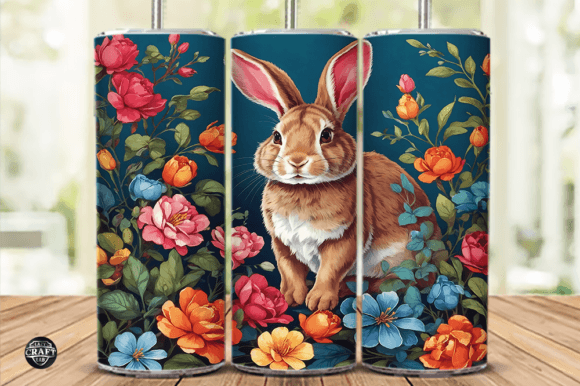
Rabbit with Flowers Skinny Tumbler Wrap
A Soft-Spoken Charm That Translates Well—But Not Everywhere
As someone who’s stitched hundreds of designs across baby onesies, boutique aprons, and Etsy bestsellers, my first impression of Rabbit with Flowers Skinny Tumbler Wrap is quiet confidence. It’s not loud or trendy—it leans into gentle whimsy: a centered rabbit nestled among loose, flowing florals, balanced vertically for narrow surfaces. The composition feels intentional—not cramped, not sparse—and the organic line weight suggests it was drawn with care, not auto-traced. That matters. When you’re embroidering for real clients—say, a new mom ordering a matching embroidered pillow cover and tea towel set—you need designs that read as handmade, not mass-produced. This one does.
Where It Shines: Thoughtful Applications Beyond the Tumbler
I tested Rabbit with Flowers Skinny Tumbler Wrap as the focal motif on a linen-cotton blend kitchen towel (3.5” tall × 9” wide hoop). It held up beautifully—especially the satin-stitched petals and the rabbit’s ear contour. The vertical flow made it ideal for narrow-format embroidery projects: sweatshirt sleeves, cap back panels, tote bag side stripes, and even baby bibs where width is limited but storytelling matters. As a machine embroidery design, it avoids over-detail in critical areas—the rabbit’s face uses subtle fill stitch instead of dense micro-satin, so it won’t pucker on lightweight cotton. That’s smart design judgment, not just pretty graphics.
For craft business owners, this works especially well as a cohesive element across product lines. I used it as an embroidered patch (heat-applied stabilizer + medium tear-away), then repeated the same motif in a printable mockup for an Etsy listing—customers instantly recognized the continuity. It reads as part of a collection, not a one-off graphic. That builds brand consistency without requiring custom illustration work.
Where to Pause—and Why
Don’t reach for Rabbit with Flowers Skinny Tumbler Wrap when stitching on highly textured fabrics like bouclé knit or thick terry cloth. The floral details soften too much; the rabbit’s outline blurs. Likewise, avoid it on stretchy fabrics unless you’re using cutaway stabilizer and reducing stitch density manually—those long, curving stems don’t forgive fabric movement.
It’s also not ideal for dark fabric without thoughtful thread color planning. The original PNG suggests light-on-dark contrast, but embroidery thread lacks the crispness of print. Test it in black-and-white mockups first—what looks delicate on screen can vanish under navy or charcoal thread. And skip it for curved surfaces like baseball caps unless you’re willing to split the design or resize significantly: the proportions rely on vertical alignment, and distortion on a dome ruins the balance.
Real-Life Use Case: A Nursery Gift Bundle
Last month, I created a personalized gift set for a baby shower: a muslin swaddle, organic cotton burp cloth, and a linen napkin—all embroidered with variations of the same motif. I adapted Rabbit with Flowers Skinny Tumbler Wrap by simplifying the outer florals for the burp cloth (smaller hoop, tighter stitch count) and keeping the full version on the napkin. Customers loved the subtle cohesion—no two pieces matched exactly, but they *felt* related. That’s the value here: it’s flexible enough to scale thoughtfully, not rigidly.
What It Adds—And What It Doesn’t Promise
This isn’t a high-density commercial embroidery file built for 10,000-unit runs. It’s a digital embroidery file with clear hand-drawn character—ideal for small shop products, craft fair inventory, or personalized gifts where charm outweighs pixel-perfect precision. It elevates a simple tote bag design into something memorable. It makes a plain sweatshirt feel curated, not generic. But it won’t replace technical applique designs for heavy-duty patches or complex multi-layered holiday embroidery.
Visually, it boosts perceived value: customers associate soft botanical motifs with care and intention. That translates directly to trust—especially for Etsy sellers or handmade shop owners positioning themselves as thoughtful creators, not drop-shipped resellers. And because it’s inherently scalable (within reason), it supports consistent branding across physical and digital design assets—think social media banners, packaging labels, or printable thank-you cards.
Practical Designer Notes Before You Stitch
- Always test on scrap fabric first—especially if pairing with textured or dark materials.
- Review stitch density before loading into your machine. If the file includes multiple layers, check whether fill stitches overlap unnecessarily.
- Confirm hoop size compatibility. While designed for skinny tumblers (likely ~3–4” wide), verify actual dimensions before resizing for apparel or accessories.
- Inspect small details like petal tips and whiskers—they’re charming but may vanish below 2.5mm height. Adjust scaling accordingly.
- Use proper stabilizer: medium tear-away for stable wovens, cutaway for knits or lightweight blends.
- Check licensing before selling finished items or bundling the file with other digital products. The listing says “INSTANT DOWNLOAD,” but commercial use rights aren’t specified—verify before launching an Etsy embroidery kit.
- Compare light/dark fabric backgrounds in mockups—not just final stitched samples—to anticipate contrast shifts.
Final Thought: A Quiet Anchor in Your Design Toolkit
Rabbit with Flowers Skinny Tumbler Wrap won’t shout from a craft fair table—but it’ll draw people in. It’s the kind of embroidery file that earns repeat orders because it feels personal, never generic. For embroidery designers building a library of reliable, emotionally resonant motifs, or for small business owners curating a signature aesthetic, it’s a quietly powerful addition. Just remember: its strength lies in context, not coverage. Use it where softness matters—on a baby blanket hem, a linen apron pocket, or a holiday tea towel rolled with twine. That’s where it becomes more than a design. It becomes part of the story.