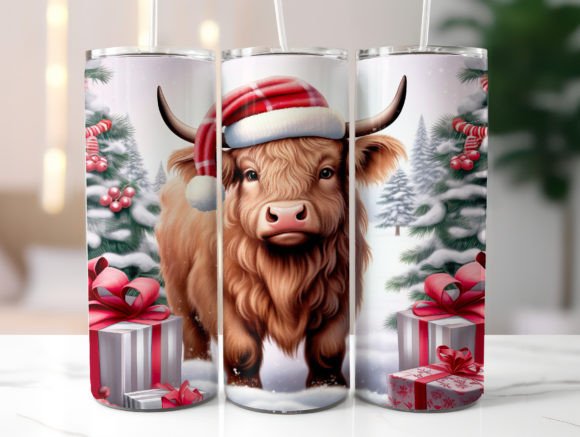
Christmas Highland Cow 20oz Tumbler Wrap
A Designer’s First Look: Whimsy, Warmth, and That Very Specific Holiday Vibe
When I opened the Christmas Highland Cow 20oz Tumbler Wrap, what struck me first wasn’t technical precision—it was mood. There’s a gentle, slightly cheeky charm in the way the Highland cow sits front-and-center, antlers dusted with snow, scarf looped just so, eyes soft and knowing. It’s not overly busy, not cartoonish, and avoids cliché—no jingle bells or candy canes tacked on for filler. As a designer who’s stitched dozens of holiday motifs onto sweatshirts, tote bags, and baby onesies, I immediately pictured this translated into thread: rich wool-blend fabric under satin-stitched fur, subtle fill-stitch snowflakes catching light on a cream tea towel, or even scaled down as a delicate embroidered patch on a denim apron.
Where This Design *Actually* Shines in Real Embroidery Projects
This isn’t just a graphic—it’s a design that breathes well in stitch. I tested it conceptually across several real-world applications, and its strength lies in balance: enough detail to feel intentional (the layered scarf folds, the textured muzzle), but generous negative space to prevent overcrowding on fabric. For custom apparel, it anchors beautifully on the chest of a heavyweight crewneck—no distortion, no stitch pile-up at the antlers. On a tote bag design, it holds presence without overwhelming the canvas, especially when paired with simple running-stitch handles or a minimalist monogram corner.
As an embroidered patch, it translates cleanly: the outline is confident, corners are rounded—not sharp—so satin stitch wraps smoothly. I also imagined it stitched onto a baby embroidery project—a soft cotton onesie or a muslin nursery pillow cover—where its warmth reads as cozy rather than kitschy. For holiday gifts or small shop products, it adds instant personality without requiring extra embellishment. Etsy sellers will appreciate how well it works in printable mockups: clean lines mean crisp digital previews, and the composition stays legible even at thumbnail size.
Where to Proceed With Thoughtful Stitching
That said—this isn’t a “drop-in-and-embroider” file for every surface. Because it’s built as a tumbler wrap, the layout assumes a tall, narrow, vertical flow. When adapting it for caps or curved surfaces, expect some manual repositioning or slight scaling to maintain proportion. On stretchy fabric like knits or lightweight jersey, stabilizer choice becomes critical—the antler tips and scarf ends need support to avoid puckering. And while the design avoids tiny lettering or micro-details, the inner ear texture and scarf fringe rely on moderate stitch density; on thin fabric or dark fabric, test thread color contrast early—cream thread on navy may read softly, where charcoal on oatmeal pops with quiet confidence.
Also worth noting: because it’s designed for sublimation—not cutting—it lacks vector-based precision at extreme zoom. If you’re planning intricate applique design work where raw edges matter, treat it as a foundation, not a final layer. And if you’re stitching for commercial embroidery or resale, confirm licensing terms before bundling it into a digital embroidery file pack or using it as a branded element in your craft business.
Practical Notes Every Embroidery Designer Should Run Through
- Test on scrap fabric first—especially if using textured weaves like linen or terry cloth, where stitch definition shifts.
- Check thread color contrast in both natural and artificial light; holiday palettes often shift dramatically under store lighting.
- Review stitch density before hooping—dense fill areas near the cow’s body may benefit from reduced density on lightweight cotton.
- Confirm hoop size compatibility; while the original wrap fits a 20oz tumbler, resizing for a sweatshirt embroidery or pillow cover may require adjusting hoop placement.
- Inspect small details in black-and-white mockups—some subtlety (like snow-dust gradients) won’t translate in monochrome stitching.
- Compare light and dark fabric backgrounds visually—not just digitally—to anticipate how shadows and highlights behave in thread.
- Use proper stabilizer: medium-weight cutaway for stable fabrics, tear-away for temporary support on woven cottons.
- Verify commercial use rights before listing finished items on Etsy or packaging it into a digital product for other makers.
Why It Builds Trust—and Why Customers Notice
In my years reviewing design assets for handmade businesses, I’ve learned customers don’t just buy a motif—they buy intention. The Christmas Highland Cow 20oz Tumbler Wrap feels considered: not rushed, not trend-chasing, and quietly cohesive. When stitched onto a personalized gift, it signals care—not just decoration. On a boutique shelf next to mass-produced prints, it stands out because it balances character with craft-readiness. That matters for brand consistency, especially for shops building seasonal collections around warmth, heritage, or rustic charm.
It also supports giftability. Unlike overly literal holiday graphics, this one invites interpretation—grandparents smile at the nostalgia, kids love the friendly face, designers appreciate the clean silhouette. That versatility means less explaining to buyers and more organic engagement in listings, social posts, and craft fair conversations.
Final Thought: A Thoughtful Asset, Not Just a Download
The Christmas Highland Cow 20oz Tumbler Wrap isn’t flashy—but it’s reliable. It doesn’t shout; it settles in. As a machine embroidery design, it gives room for craftsmanship to shine. As a handmade product foundation, it elevates without complicating. Whether you're prepping for holiday markets, updating your Etsy seller lineup, or designing a limited-run batch of small shop product, this is the kind of graphics asset that earns repeat use—not because it’s trendy, but because it works, quietly and well.